Friday, October 19, 2012

7 Dangerous acts after a meal ! ! !


1. Don’t smoke ->Experiments from experts proves that smoking a cigarette after meal is comparable to smoking 10 cigarettes (chances of cancer is higher)...
2. Don’t eat fruits immediately -> Immediately eating fruits after meals will cause stomach to be bloated with air. Therefore take fruits 1 -2 hours after meal or 1 hour before meal...
3. Don’t drink tea ->Because tea leaves contain a high content of acid. This substance will cause the protein content in the food, difficult to digest...

4. Don’t loosen your belt  -> Loosening the belt after meal will easily cause the intestine to be twisted and blocked...

5. Don’t bathe -> Bathing after meal will cause the increase of blood flow to the hands, legs and body thus the amount of blood around the stomach will therefore decrease, this will weaken the digestive system in our stomach...

6. Don’t walk about -> People always say that after a meal walk a hundred steps and you will live till 99. In actual fact this is not true. Walking will cause the digestive system to be unable to absorb the nutrition from the food we intake...

7. Don’t sleep immediately -> The food we intake will not be to digest properly. Thus will lead to gastric and infection in our intestine.

Thursday, July 19, 2012

‎$------------10 Amazing Facts About Bill Gates.------------$


1: Bill Gates earns US$250 every SECOND, that’s about US$20 Million a DAY and US$7.8 Billion a YEAR!

2: If he drops a thousand dollar, he won’t even bother to pick it up because the 4 seconds he picks it, he would’ve already earned it back.

3: The US national debt is about 5.62 trillion, if Bill Gates were to pay the debt by himself; he will finish it in less then 10 years.

4: He can donate US$15 to everyone on earth but still be left with US $5 Million for his pocket money.

5: Michael Jordan is the highest paid athlete in US. If he doesn’t drink and eat, and keeps up his annual income i.e. US$30 Million, he’ll have to wait for 277 years to become as rich as Bill Gates is now.

6: If Bill Gates was a country, he would be the 37th richest country on earth.

7: If you change all of Bill Gate’s money to US$1 notes, you can make a road from earth to moon, 14 times back and forth. But you have to make that road non-stop for1,400 years, and use a total of 713 BOEING 747 planes to transport all the money.

8: Bill Gates is 54 this year. If we assume that he will live for another 35 years, he has to spend US$6.78 Million per day to finish all his money before he can go to heaven or hell.

9: If Microsoft Windows’ users can claim US$1 for every time their computers hang because of Microsoft Windows, Bill Gates will be bankrupt in 3 days!

10: Finally He has a Twitter account, but had a problem with Facebook: “… Because the friend requests got out of hand.

Friday, June 22, 2012

Very important msg for girls in dressing room, do it first.


Just conduct this simple test: Place the tip of your fingernail against the reflective surface and if there is a GAP between your fingernail and the image of the nail, then it is GENUINE mirror. However, if your fingernail DIRECTLY TOUCHES the image of your nail, then BEWARE! IT IS A 2-WAY MIRROR!

"No Space, Leave the Place." So remember, every time you see a mirror, do the "fingernail test." It doesn't cost you anything.

REMEMBER. No Space, Leave the Place.

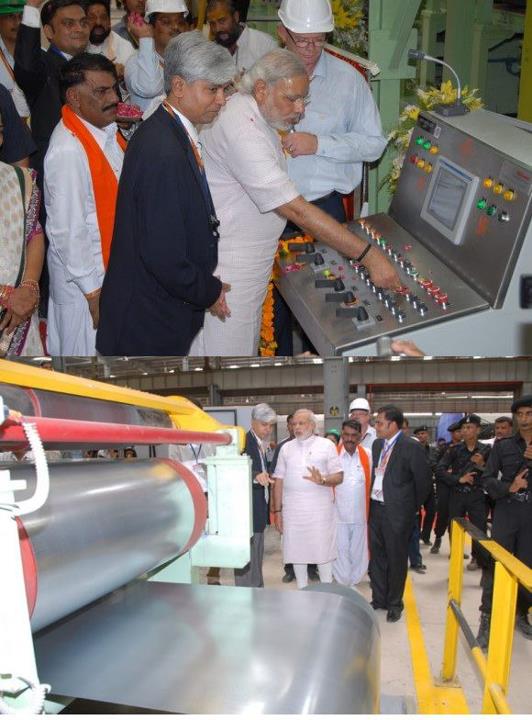
Narendra Modi inaugurates Rs.1100-cr steel plant at Bhimsar


A joint venture between India’s Ruchi group and Japan’s Mitsui group

Kutch has emerged as a steel hub of India: CM

Indore MP Sumitra Mahajan credited the growth of Gujarat to the leadership of Chief Minister Narenedra Modi. After the devastating earthquake in 2001, Gujarat has turned all the odds into opportunities, she said.

Kailash Sahara, Chairman of Indian Steel Corporation said that Chief Minister Narendra Modi’s farsighted policy of attracting developing countries to invest in the State has resulted in to significant industrial progress.

Tuesday, June 19, 2012

Incredible India!!!!!

Pic: Ganga panoramic view, Rishikesh


"Just as the swan separates milk from the water with which it has been mixed and drinks only the milk, leaving the water behind, similarly, the Paramahamsa accepts only what is Real (i.e., Absolute) rejecting what is unreal (i.e., the phenomenal world)" - Sri Ramakrishna Paramahamsa


Monday, June 18, 2012

Must Read Thriller Story!!! The Bus Conductor


Once there was a bus conductor, who was very rude to his passengers.

One day a beautiful young girl, of around 18 years,tried to board the bus, but he didn't stop the bus.

Unfortunately the beautiful young girl came under the bus and died on the spot. Angry passengers took the conductor to the police station, who in turn took him to the court.

The judge was not at all impressed with him and gave him capital punishment.

He was taken to the electrocution chamber. There was a single chair in the center of the room and a single banana peel at one corner of the room. The conductor was strapped to the chair and high voltage current was given to him. But to everyone's amazement, he survived. The judge decided to set him free, and he returned to his profession.

After a few months, this time, a good looking middle aged woman tried to board the bus but the conductor didn't stop the bus. Unfortunately, this time also, the good looking middle aged woman came under the bus and died on the spot.

Again angry passengers took him to the police station, who in turn took him to the court. The judge took one look at the conductor and gave him capital punishment. The Bus conductor was taken to the same electrocution chamber where there was a single chair in the center of the room and a single banana peel at one corner of the room. He was strapped to the chair and high voltage current was given to him. This time also, to everyone's amazement, he survived. The judge decided to set him free, and he returned to his profession.

A couple of months later, an elderly gentleman tried to board the bus.

This time the Bus conductor, remembering his earlier experiences, stopped the bus. Unfortunately the elderly gentleman slipped and died due to his
injuries. The conductor was taken to the police station and then to the court, to the same judge. Though he hadn't done anything wrong, but considering his past record the judge decided to set an example and gave him capital punishment.

The Bus conductor was again taken to the same electrocution chamber where there was a single chair in the center of the room and a single banana peel at one corner of the room. He was strapped to the chair and high voltage current was given to him.

This time he died instantly !!!!!!!!!!!

The question is why didn't he die on the first two occasions, but died instantly the third time??

Try to solve it yourselves. This is rather interesting and answer is perfectly logical. If necessary read the puzzle once again.

Still couldn't? Then see below.........

Think hard

C'mon .............

Tired....?

Wanna know the answer????

Ok........ here is the Answer............

During the first two times, the conductor was a Bad Conductor, therefore electricity didn't pass through him. But during the third time, he was a good conductor, so electricity passed through him freely and he died !!!!

Health Tip of the Day


    *   According to Japanese Scientific Research, full ripe banana with dark patches on yellow skin produces a substance called TNF (Tumor Necrosis Factor) which has the ability to combat abnormal cells. 


    *   The more darker patches it has the higher will be its immunity enhancement quality; Hence, the riper the banana the better the anti-cancer quality.

    *   Yellow skin banana with dark spots on it is 8x more effective in enhancing the property of white blood cells than green skin version.

                         ***  Eating 1-2 banana/s a day increases immunity. ***

Wednesday, May 16, 2012

BRAIN DAMAGING HABITS!!!


1. No Breakfast
People who do not take breakfast are going to have a lower blood sugar level.
This leads to an insufficient supply of nutrients to the brain causing brain degeneration.

2. Overeating
It causes hardening of the brain arteries, leading to a decrease in mental power.

3. Smoking
It causes multiple brain shrinkage and may lead to Alzheimer disease.

4. High Sugar consumption
Too much sugar will interrupt the absorption of proteins and nutrients causing malnutrition and may interfere with brain development.

5. Air Pollution
The brain is the largest oxygen consumer in our body. Inhaling polluted air decreases the supply of oxygen to the brain, bringing about a decrease in brain efficiency.

6. Sleep Deprivation
Sleep allows our brain to rest. Long term deprivation from sleep will accelerate the death of brain cells.

7. Head covered while sleeping
Sleeping with the head covered increases the concentration of carbon dioxide and decrease concentration of oxygen that may lead to brain damaging effects.

8. Working your brain during illness
Working hard or studying with sickness may lead to a decrease in effectiveness of the brain as well as damage the brain.

9. Lacking in stimulating thoughts
Thinking is the best way to train our brain, lacking in brain stimulation thoughts may cause brain shrinkage.

10. Talking Rarely
Intellectual conversations will promote the efficiency of the brain.

Share This Helpful Information With Your Beloved Ones,
Once You've Done With It.. !

Saturday, May 12, 2012

******The IAS topper who failed Class VI**********


UPSC all-India second topper Rukmani Riar did not believe in coaching and cracked the exam in her first attempt. She tells us how she did it.

Ever since the UPSC results were announced, Rukmani Riar's phone hasn't stopped ringing. 

Although Chandigarh-born Rukmani has received gold medals for her academic achievements and research during graduation and post-graduation, she says that this new feeling of success is overwhelming.

"People from all over have been trying to reach me to congratulate me and my family. It's a proud moment for all of us," beamed the 26-year-old, who holds a master's degree in social entrepreneurship from the Tata Institute of Social Sciences, Mumbai where she consistently topped her class.

What makes her second-highest nationwide UPSC score even more special is the fact that Rukmani did not opt for any coaching and cleared the civil services exam in her very first attempt. 

"If you are consistent and perseverant in your preparation, you can crack the exam without coaching," suggests the topper, who chose political science and sociology as her main subjects for the exam.

For someone who was unable to cope with the pressure of moving to a boarding school and failed in Class VI while studying at the Sacred Heart School in Dalhousie, this success is a testimony to the adage that failures are the stepping stones to success. 

"Ever since I failed in Class VI, I am scared of failure. It can be very depressing. But after that incident, I made up my mind that I won't sulk and complain. I will work hard and give things my best. I believe that if one decides to persevere and come out of that phase, nothing can stop you achieving success," advises Rukmani over the phone from Chandigarh.

"I always wanted to serve the nation," she adds. And you can well believe her -- she has interned with the Planning Commission of India and NGOs in Karnataka and Maharashtra over the last few years, researching and understanding various social policies and finding ways to help them make a positive impact upon society.

Following her success in the exam, Rukmani wants to become an IAS officer so that she can use her experience and training to serve the nation in a better way. Her father BS Riar works as a lawyer in Hoshiarpur and her mother is a housewife.

In this interview with Divya Nair, the young achiever talks about how she overcame the fear of failure, how she seeks inspiration from Aamir Khan, Shah Rukh Khan, Abdul Kalam and Manmohan Singh and offers tips to aspirants on how to crack the exam.

How did you prepare for the exam without any coaching? Kindly share your strategy for success.

I believe that if you are disciplined in your approach, you will not require any coaching. I started preparing for the exam in August 2010, because the exam was scheduled in June 2011. I had a year's time to prepare. I relied on the NCERT textbooks for study material and set daily targets -- about six hours of study a day.

I am not a very studious person, so I had to be disciplined and focus on days when I could give my best hours. There were times when I did not feel like studying, but I ensured that whenever I did, I would complete what was on my agenda even if it meant stretching my study time to eight or nine hours. 

Consistency was another factor. I know friends who study for 10 to 12 hours a day and then take a break. So they forget what they've learned and have to spend extra hours revising. I ensured that I studied everyday so as not to overburden myself when the exams approached.

Which was the most difficult part of the exam? How did you tackle it?

There was nothing difficult as such, because I had chosen my favourite subjects (political science and sociology). I believe that if you love what you do, you won't feel like you are working hard on it. 

Why did you choose to appear for the UPSC exam after your post-graduation?

I wanted to have a back-up plan. Although it was my dream to crack the exam, I did not want to risk my career after graduation. Plus, I wanted time to prepare well.

You said you did not want to risk your career. Does that mean you are scared of failure?

Yes, I am scared of failure. I was in Class IV when my parents moved me to Sacred Heart School, a boarding school in Dalhousie.

I was young and could not cope up with the change. I flunked Class VI. I was not academically bright, but failing in school was depressing for me even then.

My peers looked down upon me. I felt very disappointed that I had let down my teachers and parents. That's why I am scared of failure.

How did you overcome that phase?

Initially, I sulked and felt bad about myself. But after some time, I realised that sulking was not the solution to my situation. 

If I had to succeed, I had to find a way out of the situation. I decided to work hard. I wanted to show everyone that if I was given an opportunity, I would definitely make it worthwhile. And when I succeeded, I saw the dramatic change in people's behaviour.

I started liking the way my efforts and hard work were appreciated. I think that was when I made friends with success. 

Failure isn't bad, but it is up to each one of us, whether to take it as a lesson or a punishment. If you are willing to work hard, you can overcome any obstacle that stands in your way.
What inspired you to choose a career in civil services?

I have always wanted to serve society. I chose sociology as my major for my graduation. It was my dream to become an IAS officer. I knew I would crack the exam, but I wasn't sure that I would be among the toppers.

The majority of UPSC toppers in the last few years have been women. How does that make you feel?

I have always felt that girls are hard-working and strong-willed. If given an opportunity, they can definitely shine and showcase their talents.

At a time when girls have to fight social crimes like female foeticide, denial of primary education and dowry deaths, I am proud that we are setting a bright example for the future.

Have you been involved in any activities that you think will help you in your IAS career?

Before appearing for the exam, I wanted to understand the problems faced by people across the country. I also wanted to gain some exposure with regards to the working of the government, policy-making, developmental schemes etc.

So along with my post-graduation, I worked with several NGOs like Ashodaya in Mysore, Karnataka and micro-finance firms like Annapurna Mahila Mandal in Mumbai. While Ashodaya deals with the emancipation and empowerment of sex workers, Annapurna identifies and organises developmental activities for women in various slums across Mumbai and Pune.

I was also involved in a project for Tata Corus. They were planning to set up a new steel factory in the Ratnagiri district of Maharashtra and the project involved studying the culture and lifestyle of people in the villages of Vanvette and Aiziwal, so that we could suggest plans for their employment and empowerment. It was a part of the company's corporate social responsibilities and was a good learning experience for me.

After my post-graduation, I joined the Centre for Equity Studies in New Delhi and worked under the leadership of activist Harsh Mander. I visited urban slums in places like Jama Masjid and Yamuna Pushta to rehabilitate and help them. 

What were the people's problems you identified during the course of your internship?

I realised that problems vary according to the geography, climate and culture of people. While primary education for girls is a major concern in northern India, several youngsters are falling prey to drug addiction along the borders of Punjab and several slum areas. 

I also realised that there are government schemes for each of these problems, but as a famous bureaucrat once said, 'for every one rupee spent by the government, only 10 paise reaches the needy.' 

Be it the National Rural Health Mission Scheme or the Anganwadi Scheme, they are not implemented properly and hence the poor and underprivileged don't get what they deserve.

After becoming an IAS officer, how do you plan to address these problems?

I know it's too early to comment, but I would like to take up one thing at a time. I will concentrate on bridging the gap in the implementation process. The right schemes should reach the right people. I want to set an example of good governance with accountability.

Where do you draw inspiration from?

I am inspired by different people everyday -- from Aamir Khan's urge for perfection to Shah Rukh Khan's growth from a nobody to a superstar, each one has his own way of achieving success. 

At the same time, Abdul Kalam's selflessness and Manmohan Singh's sheer honesty and dedication to his job teach me that you can choose whatever field you want and still inspire people by your actions and do your bit for society.

I also look up to social activist and my mentor Harsh Mandera. The fact that he quit his cushy, high-paying job to serve the people only reinforced my dream to work for the nation.

Besides academics and participating in social causes, what are your other interests?

I am a very active person. You will hardly find me sitting idle. I listen to music, write poetry and watch movies. I also love travelling, meeting new people and trying out new cuisines. I am quite a foodie.
Kindly share some dos and don'ts for those who want to pursue a career in the civil services.

There are no 'don'ts': there are only dos for success. 

You have to work hard. There is no substitute for hard work.

You have to be disciplined in your approach while studying or planning your career.

And yes, dreams do come true; you just have to believe in them.

Do you have a message for our young readers?

I would like to tell them that the country needs the support and cooperation of its people to evolve from its current condition. You may not become a successful bureaucrat or join the civil services, but if you ever get a chance to serve the people in some way, you must not hesitate to take up the opportunity

Monday, April 23, 2012

Incredible INDIA ♥

Funny logic :
Large state: MAHA RASHTRA.

King place: RAJA-STHAN.

Queen place: RANI KHET.

Mr. City: SHRI NAGAR.

Rising city: UDAY PUR.

Rhythm of eyes: NAINI TAL.

Face state: SURAT.

Unmarriad girl: KANYA KUMARI.

God's gate: HARI DWAR.

Brick city: ITA NAGAR.

Saint hair: RISHI KESH.

Red nail: LAL KILA.

Call end: KOL KATA.

No zip: CHEN NAI.

Come on sun: ARUN AA CHAL.

Come in evening: AA SAM.

Go & back: GO A

And finally

Do drama: KAR NATAK :D

Saturday, April 21, 2012

Saluting Agniputri of India!!


India's first woman scientist to head a critical missile project.

Meet the woman behind Agni-V success,
Dr. Tessy thomas

It's been a challenging job for the scientist who is responsible for making the launch of Agni-V successful. Tessy Thomas may be a homemaker to her family but is known as 'Agniputri' to the world for her achievement in the field of missile technology.

It all started in Alleppey, Kerala. After a B.Tech from Thrissur Engineering College, her fascination for radar and missile systems led her to join the Defence Research and Development Organisation (DRDO).

"I joined the DRDO almost 20 years ago. Now, I am the programme director," Thomas said. Recalling her journey to the DRDO, she said, "I got the call from DRDO soon after I applied. I wanted to rest for a month, but I couldn't get the break. I still haven't got it," she said.
But it doesn't stop there. She helped in developing another path breaking technology known as RVS or "re-entry vehicle system". This lets the missile re-enter the atmosphere at a thundering velocity and a temperature of 3000 degrees Celsius, still keeping the control systems intact.
"Nobody gives you the know how of such things. We developed it on our own," Thomas said.
The real test for Dr Thomas and her team was in July 2006. 75 seconds into the flight and the missile suddenly went out of control. But Dr Thomas took it as a challenge and decided to prove a point.

"I think it was a great learning experience for all of us. We had to put it out, prove that nothing was wrong with the missile," she says.

And 10 months later, they did. The team re-launched the missile and it flew for 16 minutes. But the success came at a price. To be at the launch, Tessie left behind her sick son who had to take his board exams. But he's aptly named after the country's light combat fighter jet, Tejas and lived up to his name.

"I have no complaints. She had to do her duty to the nation and in fact she even managed to be there for me whenever I required her," Thomas's son Tejas said.
Today, Dr Thomas leads a team of 400 scientists, the majority of whom are male but it doesn't faze her.

"For scientists, there is no gender discrimination. Subject is subject, science is science. That's how we learn and move forward," she says.
Jai Hind

Wednesday, April 11, 2012

One mind blowing interview...


Interviewer : Tell me about yourself.
Candidate: I ...am Rameshwar Kulkarni. I did my Tele Communication engineering from BabanRao Dhole-Patil Inst it ute of Technology.

Interviewer : BabanRao Dhole-Patil Inst it ute of Technology? I had never heard of this college before!
Candidate : Great! Even I had not heard of it before getting an admission into it ..
What happened is – due to cricket world cup I scored badly! in 12th.I was getting a paid seat in a good college. But my father said (I prefer to call him ‘baap’) – “I can not invest so much of money”.(The baap actually said – “I will never waste so much of money on you”). So I had to join this college. Frankly speaking this name – BabanRao Dhole-Patil, can at the most be related to a Shetakari Mahavidyalaya

Interviewer: ok, ok. It seems you have taken 6 years to complete your engineering.
Candidate : Actually I tried my best to finish it in 4 years. But you know, these cricket matches and football world cup, and tennis tournaments. It is difficult to concentrate. So I flunked in 2nd and 3rd year. So in all I took 4 + 2 = 7 years.

Interviewer: But 4+2 is 6.
Candidate: Oh, is it ? You know I always had KT in maths. But I will try to keep this in mind. 4+2 is 6, good, thanks. These cricket matches really affect exams a lot.. I think they should ban it .

Interviewer : Good to know that you want cricket matches to be banned.
Candidate : No, no… I am talking about Exams!!

Interviewer: Ok, What is your biggest achievement in life?
Candidate : Obviously, completing my Engineering. My mom never thought I would complete it . In fact, when I flunked in 3rd year, she was looking for a job for me in BEST (Bus
corporation in Maharashtra ) through some relative.

Interviewer : Do you have any plans of higher study?
Candidate: he he he.. Are you kidding? Completing ‘lower’ education it self was so much of pain!!

Interviewer : Let’s talk about technical stuff. On which platforms have you worked?
Candidate : Well, I work at SEEPZ, so you can say Andheri is my current platforms. Earlier I was at Vashi center. So Vashi was my platform then. As you can see I have experience of different platforms! (Vashi and Andheri are the places in Mumbai)

Interviewer : And which languages have you used?
Candidate : Marathi, Hindi, English. By the way, I can keep quiet in German, French, Russian and many other languages.

Interviewer: Why VC is better than VB?
Candidate : It is a common sense – C comes after B. So VC is a higher version than VB. I heard very soon they are coming up w it h a new language VD!

Interviewer: Do you know anything about Assembly Language?
Candidate: Well, I have not heard of it . But I guess, this is the language our ministers and MPs use in assembly.

Interviewer : What is your general project experience?
Candidate : My general experience about projects is – most of the times they are in pipeline!

Interviewer: Can you tell me about your current job?
Candidate: Sure, Currently I am working for Bata Info Tech ltd. Since joining BIL, I am on Bench. Before joining BIL, I used to think that Bench was another software like Windows.

Interviewer : Do you have any project management experience?
Candidate: No, but I guess it shouldn’t be difficult. I know Word and Excel. I can talk a lot. I know how to dial for International phone call and use speaker facility. And very important – I know few words like – ‘Showstoppers ‘ , ‘hot fixes’, ‘SEI-CMM’, ‘quality’, ‘version control’, ‘deadlines’ , ‘Customer Satisfaction’ etc. Also I can blame others for my mistakes!

Interviewer: What are your expectations from our company?
Candidate : Not much.
1. I should at least get 40,000 in hand..
2. I would like to work on a live EJB project. But it should not have deadlines. I personally feel that pressure affects natural talent.
3. I believe in flexi-timings.
4. Dress Code is against basic freedom, so I would like to wear t-shirt and jeans.
5. We must have sat-sun off. I will suggest Wednesday off also, so as to avoid breakdown due to overwork.
6. I would like to go abroad 3 times a year on short term preferably 1-2 months) assignments. Personally I prefer US, Australia and Europe. But considering the fact that there are Olympics coming up in China in the current year, I don’t mind going there in that period. As you can see I am modest and don’t have many expectations. So can I assume my selection?

Interviewer : he he he ha ha ha. Thanks for your interest in our
organization. In fact I was never entertained so much before. Welcome to INFOSYS.

The fellow was appointed in a newly created section ‘Stress Management’ in the HRD of Infosys.

So Excellence is not the only thing Needed. Its the Unique Quality of a Person which can let anyone to Success. Work on Your own Field rather then following somebody else's Path 

Tuesday, April 10, 2012

HAT'S OFF 2 the man & his attitude...


NOTHING IMPOSSIBLE:

Winner: B. Srikanth, a visually-challenged student, who secured admission in MIT.
A staunch believer in hard work and perseverance, this 17-year-old with his excellent command over English might seem like any other teenage. But, for B. Srikanth, a visually-challenged student, nothing in life came easily. Not even the admission into Massachusetts Institute of Technology (MIT) with a full fee waiver.

Hailing from Machilipatnam, this son of a farmer completed his schooling from Devnar School for Blind. When he approached an Intermediate college to pursue his plus two in sciences, he was told he couldn’t do that. However, with the help of his mentors from school, he managed to enrol himself in M.P.C in Royal Junior College and finished his Intermediate with an impressive 92.5 per cent.

The success in Intermediate didn’t come easily. “There was no Braille in Intermediate. My teacher Swarnalatha helped me a lot by recording the entire syllabus onto audio tapes,” he says. “I took home tuition only for mathematics as it is not easy to learn this with the help of tapes,” he adds.

“Nothing in this life is impossible,” says this die-hard optimist, “We are not ‘disabled’; we are ‘challenged’. So we have to take this as a challenge and fight back,” he says.

Srikanth’s zeal to learn and reach for the stars was noticed by Ravi Kondapalli, an NRI at a conference ‘Ignite the genius within you,’ held in Indian School of Business. “I had expressed my dream of studying in the USA to Mr.Ravi and he took up the challenge to fulfil my dream,” says Srikanth. With the help of local support from Valmiki Foundation, a city-based NGO, his applications were sent to the top notch universities in the United States. Soon, his application was accepted by MIT which not only gave him admission but also waived the entire fee amount of over 56,000 US dollars.

Srikanth hopes to set his own software firm to employ skilled rural youth. “The biggest hurdle for us rural youngsters is the lack of proper education,” he says. “Primary education is a constitutional right but we are unable to give value to that right,” he adds. 

Saturday, April 7, 2012

‎|School vs College|


School : Pencil, rubber, sharpener, scale !! :)

College : Ek ball pen wo bhi friends se cheena huwa ;) :P

School : Class mein enter hone se pehle : Ma'am may i come in? (^_^)

College : Bina bethe hi Mobile kaan se laga k class se bahar !! (-___-)

School : Bag mein har subject ki books !! :)

College : Yaar ek paper toh phad ke dede :P :P

School : Class test mein Star !! ★☆

College : Full moon hi naseeb hota hai yaar !! ◑

School : Listen I like her !! ♥

College : Sambhal ke dekh saale, bhabi hai teri :D

School : Yaar Kal Test hai, Mai chutti maar lunga beemar hone ka bahaana le ke

College : (Next Day) Oye sun aaj bunk maarte \m/ ;)

Monday, April 2, 2012

PLEASE SHARE THIS..

 PLEASE SHARE THIS Use only your LEFT EAR when using Mobile Phones, and avoid using the RIGHT EAR as that makes our brain more prone to mobile radiation. This was found out by a latest research from Apollo Medical Team .

Sunday, April 1, 2012

Survival tips when your GPS System Winks Out:II


“People will start to panic, continue to move, and become even more lost.” First, try to remember your route or the location of major landmarks like rivers, roads, or, best case, a town. Move to high ground to get a better sense of your surroundings. (!!) Worst case? Pick a direction and plan to walk in a straight line. If you’re traveling in the Northern Hemisphere and wearing an analog watch set to local time, hold it flat and point the hour hand at the sun. Run an imaginary line between the hour hand and the 12 o’clock mark. This will give an approximate north-south marker.

No watch? Take a straight stick about three feet long, drive it into level ground, and mark the spot where the stick’s shadow ends. This is west. After 20 minutes, mark the shadow’s new location and connect the dots. This is a rough east-west axis. Once you’ve figured out your direction of travel, use simple point-to-point navigation to stay on course: Pick an object in the distance—a tree or mountain—and walk straight toward it. At each new point, pick another one farther ahead. Regularly use your watch to ensure you’re staying on the right heading.

BENEFITS OF EXERCISE...


LONG-TERM BENEFITS

#Decreases Risk of Heart Disease
Inactive people are 2x more likely to develop
coronary artery disease (CAD) then active people.

#Decreases Blood Pressure
High blood pressure increases the risk of heart
disease, stroke and kidney disease. Inactive people
are 2x more likely to develop high blood pressure then active people.

#Decreases Body Fat
Regular physical activity helps maintain optimal
body weight and composition.High blood pressure increases the risk of heart disease, stroke and kidney disease.

#Decreases Cholesterol Level
A high blood cholesterol level increases the risk of
heart disease. Regular exercise raises the level of
"good" cholesterol and lowers the level of the
"bad" cholesterol.

#Decreases Risk of Diabetes
Physical activity lowers the risk of type 2 diabetes
and increases glucose uptake for those who
already have diabetes. Fit women have diabetes
66% less often than unfit women.

#Decreases Risk of Cancer
Physical activity lowers the risk of colon and breast cancer. Decreases Risk of Osteoporosis
Regular exercise delays bone loss and promotes
bone formation.

#Decreases Arthritis Symptoms
Regular exercise helps keep joints flexible and
helps build muscle to support the joint.

#Decreases Number of Sick Days
Exercisers feel sick almost 30% less often than non-
exercisers.

#Decreases Chance of Premature Death
Fit people live longer than unfit people.


SHORT-TERM BENEFITS

#Relaxes and Revitalizes
Physical activity reduces mental and muscular
tension, and at the same time, increases
concentration and energy level.

#A Break From Daily Routine and Worries
Physical activity is like a mini-vacation—you’re
allowed to have fun.

#Helps You Feel Good About Yourself
Physical activity increases your self-esteem and
self-confidence 

AMAZING FACTS ABOUT DOLPHINS...


~They have live birth, just like us! Babies are called calves.

~ They are born with hair. What? Yes, babies are born with whiskers just above their rostrum, which falls out immediately after birth. You can still see the small black spots on adult dolphins above the rostrum where these used to be.

~ They breathe air. Dolphins cannot breathe under water. They breathe out of their blowhole. This is why you should never attempt to put anything in their blowhole, because this is their route to breathe and make sounds. But they can hold their breath for amazing amounts of time! 7 minutes is no problem for a bottle nose dolphin, other types can vary. But they do need to come up for a breath.

~Baby dolphins drink milk just like other mammals that produce milk for their offspring. The baby will swim along with its mother while drinking.

~They are also warm-blooded just like us.

~They can jump up to 20 feet above water.

~They have 100 teeth.

~Some kinds of dolphins can hold their breath for 30 minutes.

~The dolphin may eat up to 30 pounds of fish a day.

~The baby dolphin can stay with his mother for two to three years.

~The dolphin can live to be 50 years old. 

Friday, March 30, 2012

Technology matters a LOT!!!

1GB 20 years ago and 1GB now. See the difference how technology is moving..!!

Hard disk with a capacity of 5MB in olden days


PROUD TO BE AN INDIAN...


Let the world know what we stand for.


There are 3.22 Million Indians in America.
38% of Doctors in America are Indians.
12% of Scientists in America are Indians.
36% of NASA employees are Indians.
34% of MICROSOFT employees are Indians.
28% of IBM employees are Indians.
17% of INTEL employees are Indians.
13% of XEROX employees are Indians.

        You may know some of these facts. These
 facts were recently published in a German Magazine, which deals with WORLD HISTORY FACTS ABOUT INDIA.

        India never invaded any country in her last 100000 years of history. India invented the Number System. Aryabhatta invented zero. The World's first university was established in Takshila in 700BC. More than 10,500 students from all over the world studied more than 60 subjects. The University of Nalanda built in the 4th century BC was one of the greatest achievements of ancient India in the field of education. Sanskrit is the mother of all the European languages. Sanskrit is the most suitable language for computer software reported in Forbes magazine, July 1987.

        Ayurveda is the earliest school of medicine known to humans. Charaka, the father of medicine consolidated Ayurveda 2500 years ago. Today Ayurveda is fast regaining its rightful place in our civilization. Although modern images of India often show poverty and lack of development, India was the richest country on earth until the time of British invasion in the early 17th Century. The art of Navigation was born in the river Sindh 6000 years ago. The very word Navigation is derived from the Sanskrit word NAVGATIH. The Word navy is also derived from Sanskrit 'Nou'.

        Bhaskaracharya calculated the time taken by the earth to orbit the sun hundreds of years before the astronomer Smart; Time taken by earth to orbit the sun: (5th century) 365.258756484 days. Budhayana first calculated the value of pi, and he explained the concept of what is known as the Pythagorean Theorem. He discovered this in the 6th century long before the European mathematicians Algebra, trigonometry and calculus came from India; Quadratic equations were by Sridharacharya in the 11th century; The largest numbers the Greeks and the Romans used were 10^6(10 to the power of 6) whereas Hindus Used numbers as big as 10^53 (10 to the power of 53) with specific names as Early as 5000 BC during the Vedic period. Even today, the largest used number is Tera 10^12(10 to the power of 12).

        According to the Gemological Institute of America, up until 1896, India was the only source for diamonds to the world. USA based IEEE has proved what has been a century-old suspicion in the world scientific community that the pioneer of Wireless communication was Prof. Jagdeesh Bose and not Marconi.

       The earliest reservoir and dam for irrigation was built in Saurashtra. According to Saka King Rudradaman I of 150 BC a beautiful lake called 'Sudarshana' was constructed on the hills of Raivataka during Chandragupta Maurya's time.

       Even Chess (Shataranja or AshtaPada) was invented in India.

       Sushruta is the father of surgery. 2600 years ago he and health scientists of his time conducted complicated surgeries like cesareans, cataract, artificial limbs, fractures, urinary stones and even plastic surgery and brain surgery. Usage of anesthesia was well known in ancient India. Over 125 surgical equipment were used. Deep knowledge of anatomy, etiology, embryology, digestion, metabolism, genetics and immunity is also found in many texts.

        When many cultures were only nomadic forest dwellers over 5000 years ago, Indians established Harappan culture in Sindhu Valley (Indus Valley Civilization) the place value system, the decimal system
was developed in India in 100 BC.

QUOTES ABOUT INDIA:

        Albert Einstein said: We owe a lot to the Indians, who taught us how to count, without which no worthwhile scientific discovery could have been made.
        
         Mark Twain said: India is the cradle of the human race, the birthplace of human speech, the mother of history, the grandmother of legend, and the great grand mother of tradition. Our most valuable and most structive materials in the history of man are treasured up in India only.

        French scholar Romain Rolland said: If there is one place on the face of earth where all the dreams of living men have found a home from the very earliest days when man began the dream of existence, it is India.

        Hu Shih, former Ambassador of China to USA said: India conquered and dominated China culturally
for 20 centuries without ever having to send a single soldier across its border.


        All the above is just the TIP of the iceberg, the list could be endless. BUT, if we don't see even a glimpse of that great India in the India that we see today, it clearly means that we are not working up to our Potential and that if we do, we could once again be an ever shining and Inspiring country setting a bright path for rest of the world to follow. I Hope you enjoyed it and work towards the welfare of INDIA.

PROUD to be an INDIAN.